EU AI Pact: a look at the dialogue with businesses waiting for the AI Act
As parts of the EU AI Act are delayed and the debate over regulation versus innovation intensifies, the European Commission is pushing ahead with the AI Pact, a voluntary initiative to prepare companies for compliance. This article examines who has joined the Pact, what commitments they have made, and how this new framework could shape trust, transparency, and the future of AI governance in Europe and beyond.
OP-EDS
Alessio Caramitti
2/9/20263 min read
While some of the obligations introduced by the AI Act are being delayed, and fiery debates about the balance between regulation and innovation continue, the European Commission is moving forward with the AI Pact. This voluntary programme aims to engage with stakeholders and prepare them for compliance with the AI Act.
The AI Pact, launched in September 2024, is structured around two Pillars. Pillar I creates a knowledge-sharing hub where all kind of stakeholders can exchange information with each other and with the AI Office. In exchange, the AI Office organises webinars on the AI Act and collects feedback. More than 1000 entities have joined the AI Pact under this pillar.
Pillar II is intended for companies. Its purpose is to drive companies directly into implementing the AI Act. It does this by setting out concrete actions and timelines to help companies achieve compliance. The three main commitments relate to AI governance, mapping of high-risk systems, and raising AI awareness and literacy among staff. The pillar also includes additional, optional commitments for AI providers and developers.
We collected generic data on 223 of the 230 companies that signed the pledges introduced by Pillar II. The seven missing companies were either unreachable or subsidiaries of companies that had signed the Pact themselves.
The global reach of this initiative is immediately clear: 93 companies – accounting for 42% of the total – are based outside the European Union. The vast majority of these are in North America (47 in the USA and three in Canada), followed by 16 in the Asian continent (including five in India and two in China), two in Australia, one in Africa (Benin) and one in Russia. Finally, twenty-three companies are based in European countries that are not part of the EU: twelve in the UK, six in Switzerland and five in Norway.
The companies from the EU are 130, coming from 16 Member States and particularly concentrated in France (26), Germany (25), and Italy (18), followed by Spain (13) and the Netherlands (13).
Overall, the majority of these companies operate in the IT sector (70%), including in fields such as telecommunications, software development and data processing and analysis. The list includes AI providers and deployers, as well as companies that are both. Many of these are specialised in specific markets, ranging from human resources and healthcare to productivity, education, and training. The second most common sector in which signatories are active is professional, scientific and technical activities (8%), particularly in legal, accounting and advertising services. The remaining companies operate mainly in manufacturing and financial and insurance activities, as well as administrative and support services, including employment and security services.
Large companies (>750 employees) constitute slightly more than half of the total signatories (114, or 51%), but they hold more weight among extra-EU companies. Indeed, while the voluntary pledges of the AI Act have mainly attracted large companies from abroad (63% of extra-EU signatories), reactions within the EU have been more heterogeneous. In the EU, large companies account for less than half of the signatories (42%), alongside a significant number of micro (19%), small (18%) and medium (17%) enterprises. Meanwhile, small-mid-cap (SMC) companies, defined as those with between 250 and 750 employees, account for only 3% of EU signatories.
The pledges to which these companies have subscribed have the potential to concretely promote some practices that could improve both the awareness around and the transparency of AI systems. In light of other legislative actions, such as the Digital Omnibus, which are removing some obligations (e.g. raising awareness within the company) and delaying others (those for high-risk systems), the AI Pact serves a mechanism for tracking voluntary commitments by companies. This could significantly increase trust in them and in European institutions, as well as promoting the development and deployment of inherently transparent and trustworthy systems and possibly reinforcing the “Bruxelles effect” once again.
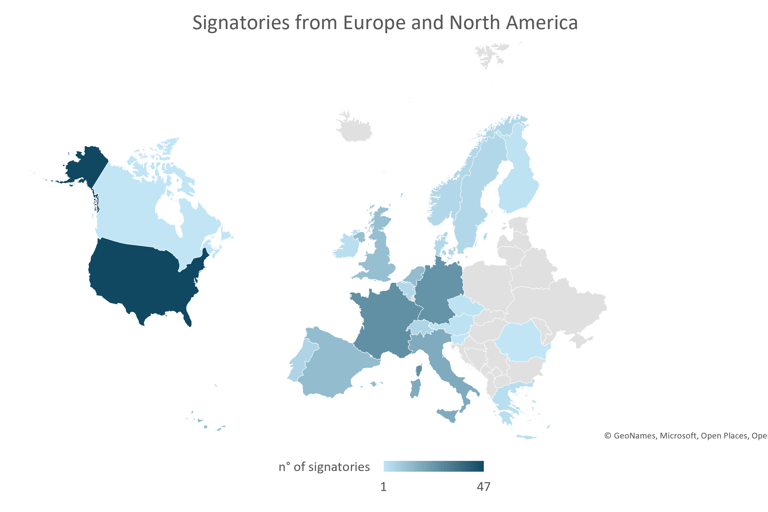
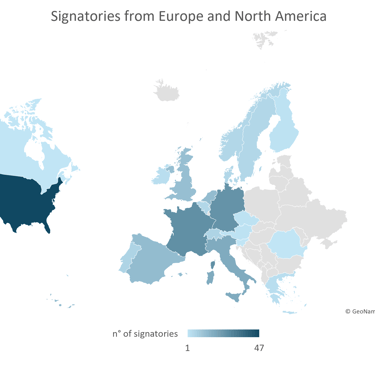
This visualisation portrays the geographical distribution of companies that have signed the pledges introduced by the AI Pact, focusing on the two regions with the highest number of signatories: Europe and North America.
Engage • Educate • Innovate
Techno Polis, your Partner in Technology, Policy, and Innovation.
Privacy Policy
© 2026. All rights reserved.
Receive our insights
Get in touch and join our Forum