
AI Microchip Market: The GPU Monoculture Is Over. Here’s What Replaces It.
The age of a single, dominant AI chip is ending. This article explores how rising inference costs, new specialised processors, and custom silicon are breaking the GPU monoculture, reshaping the economics of AI hardware and ushering in an era where performance is defined not by raw power, but by the right chip for the right workload.
OP-EDS
Alessandro Marchesini, Co-Founder Techno Polis
2/9/20263 min read
For a long time, the hardware strategy for artificial intelligence was simple: buy Nvidia. The H100 was not just the best option; thanks to the Compute Unified Device Architecture (CUDA), the software platform that made programming these chips viable, it was effectively the only option. That single-vendor dominance gave Nvidia a near-total lock on the market, holding about 92 per cent of discrete Graphics Processing Units (GPUs) by early 2025.
But markets hate monopolies, especially expensive ones. We are seeing the breakup of that consensus. It is happening because the economics of AI have flipped. In the early days, budgets went to training, building the brain. Now, the money is in inference, using the brain. According to market intelligence from Quantum Space, inference spending hit 55 per cent of total AI infrastructure costs in 2025 and is projected to pass 70 per cent by 2027.
That financial tipping point changes the engineering logic. Training demands massive flexibility and raw throughput, which GPUs deliver beautifully. Inference is a different beast; it demands low latency and low cost-per-token. Using a general-purpose H100 to serve chat queries is like using a Formula 1 car to deliver food: it works, but the operating costs will kill you.
Google saw this coming years ago. Their Tensor Processing Unit (TPU) strategy is boring, vertical, and ruthlessly effective. By stripping out the graphics-legacy silicon and focusing entirely on neural network maths, Alphabet reports that its TPU v5e delivers roughly 4x better performance-per-dollar than comparable GPU instances.
This is not just marketing. For a hyperscaler burning billions on electricity, "performance-per-dollar" is the only metric that matters. Analysis by Saxo Bank suggests that moving suitable workloads to TPUs has slashed inference costs by up to 65 per cent in some deployments. Google does not need to beat Nvidia on raw specs; they just need to beat them on the monthly bill.
While Google optimises for cost, others are attacking the physics. The biggest bottleneck in modern AI is not compute; it is memory bandwidth. Moving data from memory to the processor takes time and burns power.
Cerebras Systems took a sledgehammer to this problem. In March, they announced their Wafer Scale Engine (WSE-3), a chip the size of a dinner plate packing 4 trillion transistors and 44GB of Static Random Access Memory (SRAM) right on the silicon. By keeping the model on-chip, they eliminate the memory transit penalty entirely. The result is distinct: Cerebras claims Llama-class inference speeds exceeding 1,800 tokens per second. That is a 20x jump over Nvidia’s Blackwell generation for specific tasks. It is a niche approach, but for latency-critical applications, it solves a problem standard GPUs physically cannot.
Then there is the "do it yourself" crowd. OpenAI’s partnership with Broadcom signals that the biggest players are done paying the "general-purpose tax". By defining a model architecture with precision, down to specific attention kernels and reduced-precision formats like 8-bit Floating Point (FP8), engineers can build silicon that executes that exact workload and nothing else. This approach sacrifices flexibility; but in exchange, it unlocks a level of efficiency that merchant silicon cannot match.
Quantum computing, previously a fringe, is now hardening into something resembling engineering. In a recent breakthrough announced by Microsoft, the tech giant demonstrated 12 highly reliable logical qubits created from Quantinuum’s H2 system, proving the ability to create stable, error-corrected units from noisy raw components. That does not mean quantum ChatGPT is arriving soon. It means we are seeing the start of a specialised tier for problems, like molecular simulation, that classical silicon will never solve efficiently.
Nvidia remains the king of training. If you are researching the next frontier model, you are still buying H100s or Blackwells. But the default setting is gone. The market is fracturing into a diverse ecosystem of Application-Specific Integrated Circuits (ASICs), custom silicon, and monster wafers.
The era of "one chip to rule them all" is finished. The era of the right tool for the job has finally begun.
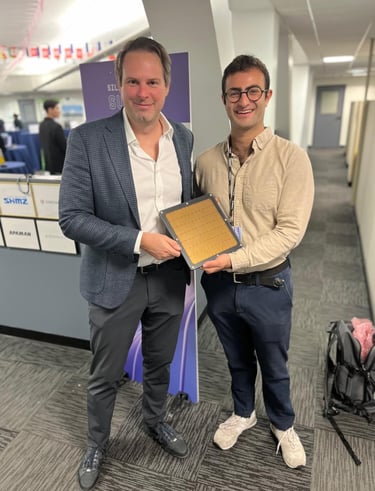
The author and Asher Dayanim (Cerebras) at a recent event in Silicon Valley
Engage • Educate • Innovate
Techno Polis, your Partner in Technology, Policy, and Innovation.
Privacy Policy
© 2026. All rights reserved.
Receive our insights
Get in touch and join our Forum